
How RISE with SAP Simplifies the Migration to S4/HANA?

How RISE with SAP Simplifies the Migration to S4/HANA?
A digital transformation is no longer an option for companies aiming for success in today’s fast-paced business environment. The channels and methods of doing business in the digital world are constantly evolving, thus, adapting to these constant changes is the key to stand out from the competition. Therefore, it becomes a priority to become smart businesses powered by the right technologies and infrastructures.
It has also become one of the most significant factors shaping businesses’ top organizational goals. The results of IDC’s worldwide COVID-19 Impact on IT Spending Survey verify this further:
- 55% of the respondents want to digitally enhance their products and services.
- 41% need to invest in technology to close digital transformation gaps.
- 49% want to future-proof their business.
- 38% want to accelerate the pace of digital transformation and innovation.
SAP has a long history of implementing more efficient workflows into its products and its current enterprise application suite is SAP S/4HANA. Although this intelligent ERP suite provides the digital core for businesses toward their objectives, overcome challenges, unlock opportunities, and upgrade business processes, there are some factors to consider before migration. Because migrating to new ERP systems demands massive organizational change and financial investment from businesses.
That’s why we focused on how RISE with SAP enables companies to carry out a holistic digital transformation and simplifies migration to SAP S/4HANA in this article.
An Overview of SAP S/4HANA
SAP S/4HANA is the latest version of the SAP Business Suite. As we get closer to the deadline for SAP ECC 6.0 support in 2027, it is on the business world’s agenda.
We can define SAP S/4HANA as an intelligent ERP solution that provides businesses with many advantages from having the strongest supply chain to providing the best customer experience with its integrated solutions and cloud services. This high-tech service can rapidly increase business value through agile delivery, easy integration with other systems, complying with best practice methodology, and also providing support for platform-level expansion through the SAP HANA Cloud Platform.
Enterprises that switch to SAP S/4HANA manage their business processes more efficiently and make more accurate and fast decisions while they become prepared for the difficulties they may encounter. According to PwC research on The Journey to SAP S/4HANA, enterprises have extremely high expectations for the benefits of the solution, and yet, S/4HANA managed to exceed them.
The Advantages of SAP S/4HANA
SAP S/4HANA enables you to stand out in the competitive environment by encouraging you to reshape business models with cloud computing and increase innovation with cutting-edge technology applications.
SAP S/4HANA capabilities can be renewed instantly and allow to make agile decisions according to current conditions while increasing the efficiency of business processes. The advantages of SAP S/4HANA can be listed as follows:
- Differentiation in your business model thanks to machine learning
- The opportunity to evaluate information more effectively and increase performance with the support of Artificial Intelligence
- Real-time advanced analytics with 30% less effort
- Causes fewer errors with improved user experience
- Easily access from any device via a web browser
- Eliminates confusion in your IT environment such as batch processing, delays, unreliable data, and temporary enhancements
- Saving 50% in data storage area with in-memory and column-oriented database
You can quickly take advantage of all the advanced capabilities of smart ERP SAP S/4HANA and the benefits it will provide to your business thanks to its flexible setup options. Furthermore, you will be able to obtain a more effective and successful user experience.
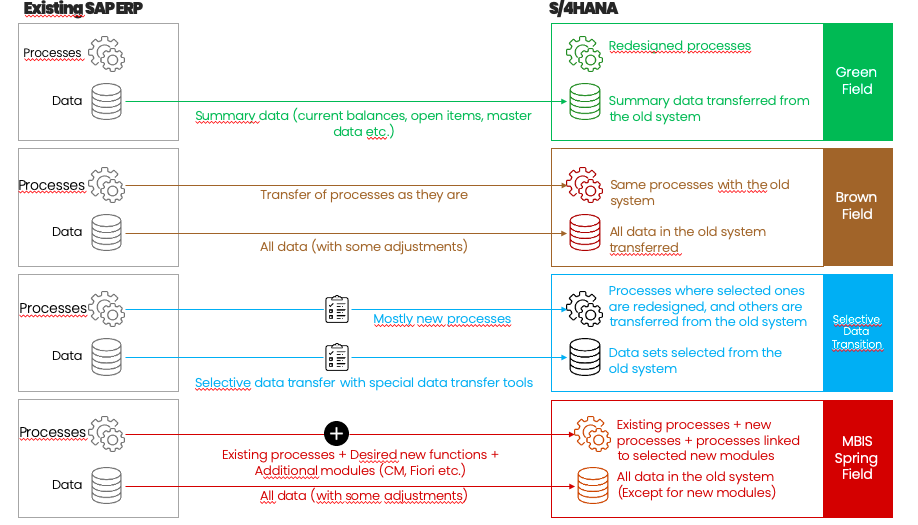
But keep in mind that the SAP S/4HANA conversion methods must be specific to the company. As it’s a complex process that can impact an organization’s infrastructure on different levels, a substantial evaluation is required on the current condition and specific needs.
And this is when RISE with SAP’s holistic approach comes into play.
RISE with SAP
In January 2021, SAP announced its new service ‘RISE with SAP’, which aims to help customers become smart businesses by executing digital transformation with a holistic approach. It focuses on accomplishing businesses’ digital transformation with a single package suitable for the specific plans and conditions of your business.
RISE with SAP provides Business Transformation as a Service by leveraging a collection of related technologies: SAP S/4HANA Cloud, SAP Business Technology Platform, SAP business networks, and SAP’s business process intelligence solutions. It includes private and public cloud deployment options of SAP S/4HANA. Offering everything your business needs with a single package, RISE with SAP removes the challenges of migration and simplifies the path to SAP S/4HANA.
RISE with SAP helps you to manage all transactions in your transformation journey with a single contract without high investments. In addition, the service you receive provides a fast ROI, with a reduction of up to 20% in the total cost of ownership (TCO) within five years.
RISE with SAP packages include five core elements:
- Business process intelligence, starter pack
- SAP S/4HANA Cloud
- Embedded services and tools
- SAP Business Technology Platform cloud credits
- SAP Business Network Starter Pack
RISE with SAP enables you to conduct business transformation as a service, go beyond traditional in-house technology, move to the latest cloud technology, and achieve digital flexibility.
At this point, let’s discover how it enables you to execute business process transformation and makes it easier for you to migrate to the intelligent ERP, SAP S/4HANA:
1. Become a Smart Business
The SAP Business Technology Platform provides a single semantic layer to a business, and the foundation for a holistic business transformation. This approach helps to keep the core clean, ensuring easier consumption.
SAP S/4HANA Cloud has built-in artificial intelligence, robotic process automation, advanced analysis, and flexible deployment options depending on the needs of an enterprise. This allows customers to access one of the world’s largest business networks, including SAP’s suppliers, logistics, and asset intelligence networks, allowing them to manage their entire supply chain to respond faster to changing market conditions.
2. Realize Technical Migration
SAP tools and services support the entire technical journey of transformation. This includes automated services to help migrate to modular and standard solution environments for faster innovation consumption in the cloud, as well as seamless transition and technical architect support to assist in adopting this transition. In addition, the cloud infrastructure customers prefer to work in an SAP data center or with a hyperscale without data and system lock.
3. Redesign Your Business Processes
The smart business process model is built on SAP’s business model and the process expertise gained by working with more than 400,000 customers in 25 industries. In this way, customers can continuously analyze how their business processes are performing, can compare them to industry standards, and easily adapt to new requirements and business demands. Businesses achieve smart business processes through the direct connection of SAP to workflow, robotic process automation (RPA), and other artificial intelligence (AI) services.
Why RISE with SAP?
Now, let’s have a look at the distinctive reasons to choose RISE with SAP for your S/4HANA migration. RISE with SAP, helps you to:
- get low-code or no-code capabilities to extend SAP solutions, intelligent robotic process automation (RPA) to drive automation, and world-class workflow service to change processes instantly.
- easily complete, grow and integrate SAP, partners, and third-party solutions using the same data model and platform services as SAP applications.
- access more than 2,200 application programming interfaces (APIs) to help integrate with on-premises, cloud and non-SAP systems.
- guide your business in real-time with a single semantic data layer, get high-quality data for analysis, planning, and AI scenarios.
- choose how to spend cloud credits, monitor service usage in real-time to better understand project costs, and get charged only for those used with consumer credits on the SAP Business Technology Platform (SAP BTP).
End-to-End Business Transformation with RISE with SAP
The migration to S/4HANA comes with difficulties for many existing on-premise and SAP ERP customers, but RISE with SAP enables this process to become much easier with a single package for holistic transformation.
Not only does it help companies to overcome the challenges of S/4HANA migration, but also it unlocks the real value of their S/4HANA Cloud. Only through RISE with SAP can you reach the service, solution, and support you need for the holistic business transformation under your own terms.
If you want to get more information about RISE with SAP and to immediately carry out the end-to-end digital transformation to become a smart business, we are here to help.

Optimize Your SAP System with Application Management Services
Optimize Your SAP System with Application Management Services Digital transformation has been a part of our lives for a while now. And yet, its speed...
Read More
2026 SAP Cloud ERP Guide – A Comprehensive Roadmap for Choosing the Right ERP
2026 SAP Cloud ERP Guide – A Comprehensive Roadmap for Choosing the Right ERP In the era of digitalization, ERP systems are essential tools for...
Read More
Increasing Performance with SAP SuccessFactors
Increasing Performance with SAP SuccessFactors Enhancing operational performance is essential for businesses, with research indicating it can result...
Read MorePlease contact us for further information


