
Customer Experience: 5 Proven Strategies to Grow Your Sales (2026 Guide)

Customer Experience: 5 Proven Strategies to Grow Your Sales (2026 Guide)
Gartner reported in 2025 that 60% of customer service agents failed to promote available self-service options, highlighting a gap between digital service investment and frontline execution. Many companies invest heavily in products and marketing, yet lose revenue at the exact moments when customers interact with them. So where does the value leak, and what can businesses do about it?
What Is Customer Experience (CX) and Why Does It Matter in 2026?
Customer experience (CX) is the sum of every interaction a customer has with a brand, from the first search query and website visit to the purchase, the delivery, and the support conversation that follows. Unlike a single touchpoint, CX is cumulative. A product can be excellent, but if onboarding is confusing or support takes days to respond, customers remember the friction, not the features.
In 2026 this matters more than ever because customers have more choices and less patience. Digital channels make switching providers easy, and AI tools are raising expectations for speed and personalization. Gartner research published in August 2025 found that technologies supporting digital-first service, such as self-service and live chat, are expected to overtake traditional phone and email as the most valuable service technologies for customer service leaders within the next two years. Companies that design for digital convenience are better positioned to meet that expectation.
CX vs. Customer Service: What Is the Difference?
Customer service is one part of customer experience, not a synonym for it. Customer service is the reactive function: answering questions, resolving complaints, and fixing problems when they occur. Customer experience covers the whole relationship, including marketing messages, product usability, pricing transparency, billing, and the way a company follows up after a purchase. A brand can have a friendly support team and still deliver a poor experience if its checkout process is confusing or its emails are irrelevant. The practical lesson is to treat service as one channel within a broader CX strategy, owned jointly by marketing, product, sales, and operations.
The Real Cost of a Poor Experience
Poor experiences carry a hidden cost that rarely appears on a balance sheet. Customers who struggle to get help often do not complain; they simply leave, and they may share their frustration with others. The Gartner findings on self-service illustrate the point. When agents do not promote the self-service options available to customers, customers may be pushed toward more expensive channels, while their own effort increases. Measuring these losses is the first step toward reducing them, which is why the metrics discussed later in this article matter.
5 Core Customer Experience Strategies That Drive Sales
The following five strategies are practical starting points for most organizations. Each one can be piloted on a small scale before being expanded across the business.
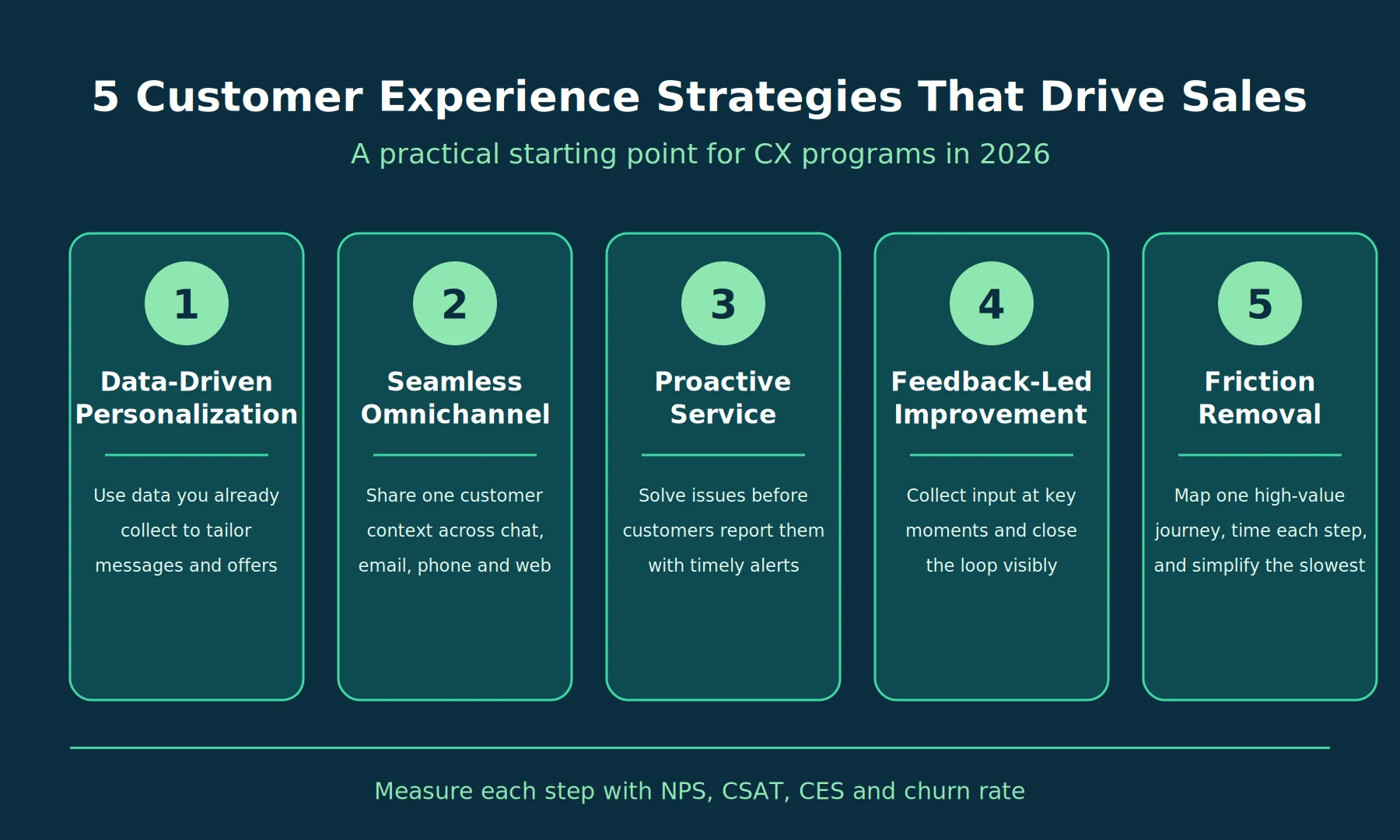
Figure 1: The five core customer experience strategies at a glance.
Strategy 1: Data-Driven Personalization
Personalization means using customer data to tailor messages, offers, and recommendations to individual needs. The principle is straightforward, but execution often fails when data sits in disconnected systems. To begin, map the data you already collect, such as purchase history, browsing behavior, and support tickets, and identify two or three decisions where a more relevant message would change the outcome. A retailer might send replenishment reminders to customers who buy consumables, for example, or a software company might show onboarding content based on the features a user has already tried. Start with clear use cases, respect consent and privacy rules, and measure the lift against a control group before expanding.
Strategy 2: Seamless Omnichannel Experience
Customers rarely stay in one channel. They might research on a mobile device, ask a question on social media, and complete the purchase on a laptop. An omnichannel approach ensures that each channel shares the same customer context, so the customer does not have to repeat information. The practical steps are to unify customer records, give agents access to interaction history regardless of channel, and make handoffs between chat, email, and phone smooth. Companies should audit their journeys channel by channel and look for the points where customers are asked to start over, because those breaks are where frustration and abandonment occur.
Strategy 3: Proactive Customer Service
Proactive service identifies and addresses problems before customers report them. Examples include sending delivery updates when a shipment is delayed, alerting a subscriber before a payment fails, or reaching out when product usage patterns suggest a customer is stuck. To implement this, combine operational data with simple alert rules, and prioritize the issues that generate the most repeat contacts. Proactive messages should be informative and brief, and they should always offer a clear next step. Done well, proactive service reduces inbound volume and strengthens trust, because customers feel the company is paying attention.
Strategy 4: Continuous Improvement Driven by Feedback
Customer feedback is only valuable when it changes something. Organizations should collect input at key moments, such as after a support interaction, following onboarding, or at renewal, and keep surveys short so response rates stay high. The more important step is closing the loop: categorize comments by theme, assign owners for recurring issues, and tell customers when their input led to a change. Many teams find that a small number of root causes account for most complaints, so addressing those first produces visible results quickly.
Strategy 5: Removing Friction Across the Customer Journey
Friction is any obstacle that makes it harder for a customer to achieve their goal, such as unclear pricing, excessive form fields, slow page loads, or confusing account setup. Removing friction often delivers results faster than adding new features. A practical approach is to map the customer journey for one high-value task, such as ordering a product or resolving a billing question, then time each step and note every point where customers hesitate or abandon. Simplifying those steps often improves conversion and reduces support load at the same time.
How to Measure Customer Experience: Which Metrics Matter?
Improvement requires measurement. No single metric captures the full picture, so most organizations use a small set of complementary indicators. The table below summarizes four widely used measures.
| Metric | What It Measures | Typical Question | Best Used For |
| NPS | Likelihood to recommend | How likely are you to recommend us to a friend or colleague? (0 to 10) | Tracking overall loyalty over time |
| CSAT | Satisfaction with a specific interaction | How satisfied were you with your experience today? | Evaluating support interactions and touchpoints |
| CES | Effort required to get something done | How easy was it to resolve your issue? | Finding friction in processes |
| Churn rate | Share of customers lost over a period | What percentage of customers cancelled or stopped buying? | Measuring retention and business impact |
Net Promoter Score (NPS): Understanding Your Advocates
NPS asks customers how likely they are to recommend a company on a scale from 0 to 10. Respondents scoring 9 or 10 are classified as promoters, those scoring 7 or 8 as passives, and those scoring 0 to 6 as detractors. The score is the percentage of promoters minus the percentage of detractors. NPS is most useful as a trend line rather than a one-time number, and it becomes more actionable when paired with an open-ended follow-up question asking what drove the score.
Customer Satisfaction Score (CSAT): Measuring Satisfaction in the Moment
CSAT typically asks customers to rate a specific interaction, such as a support conversation or a purchase, often on a five-point scale. Because it is tied to a recent event, CSAT helps teams see which touchpoints are performing well and which need attention. Its limitation is that it captures a moment rather than the overall relationship, so it works best alongside broader measures.
Customer Effort Score (CES): Making Customers’ Lives Easier
CES asks how much effort a customer had to expend to complete a task. The premise is that reducing effort tends to build loyalty more reliably than delighting customers in isolated moments. Low-effort results highlight processes that need simplification, and CES is particularly useful for evaluating self-service flows and support resolution paths.
Churn Rate: Understanding Where You Lose Customers
Churn rate measures the percentage of customers who stop doing business with a company during a given period. It is a direct indicator of retention and is closely tied to revenue. Churn is most useful when analyzed by segment, lifecycle stage, and reason for leaving. Combining churn data with NPS and CES often reveals whether customers are leaving because of product gaps, service failures, or price.
Individually, none of these metrics tells the full story, so the most useful approach is to treat them as a connected measurement program. Start by agreeing on a small number of definitions that everyone in the organization uses, then review the scores together each month. Pair each score with a short qualitative review of the comments behind it, and assign an owner to every metric so that changes in the numbers lead to decisions. Over time, teams that follow this discipline tend to move from reporting scores to explaining them, which is the step that turns measurement into better customer experiences.
Transforming Customer Experience with Technology and AI
Technology can extend what human teams are able to do, but it works best when it is designed around a clear customer goal. Three areas deserve particular attention. Organizations that want to build these capabilities into their own platforms often work with a digital engineering partner, such as Nagarro’s customer experience services, to connect data, channels, and systems.
Always-On Chatbots and Virtual Assistants
AI-powered assistants can answer common questions at any hour, guide customers through account tasks, and route complex issues to human agents with the relevant context attached. Gartner reported in December 2024 that 85% of customer service leaders planned to explore or pilot customer-facing conversational generative AI in 2025. Adoption is growing, but the quality of the experience depends on the knowledge base behind the assistant, clear escalation paths, and transparency that the customer is speaking with an automated system. Customers stuck in a loop with a bot are far more likely to leave than customers who can reach a person easily.
Analytics That Anticipate Customer Behavior
Predictive analytics can flag customers who are likely to churn, identify the products they are most likely to need next, and highlight segments where service demand is rising. The value lies in acting on these signals. A churn-risk score is only useful if it triggers a clear intervention, such as a check-in call, a tailored offer, or a service review.
Automating Processes to Free Up Human Time
Automation removes repetitive tasks such as ticket tagging, data entry, and status updates, giving employees more time for complex, high-empathy interactions. Agent-assist tools, which suggest responses and surface relevant customer history during a conversation, are one example. Gartner predicted in its 2025 technology research that 73% of customer service organizations would have implemented agent-assist solutions by the end of 2025. The goal is not to replace people but to let them focus on the moments where judgment and empathy matter most.
Customer Experience in Practice: Global and Local Success Stories
Abstract strategies become easier to evaluate when they are tied to real results. The examples below come from public award programs and reports. The figures are reported by the organizations and awarding bodies named in each case, and they illustrate what is possible rather than guaranteeing similar outcomes elsewhere.
Global Example 1: Nedbank Builds CX Into Its Operating Model
Nedbank, one of the largest banks in South Africa, began its customer experience transformation in 2010 and doubled down on it in 2021 as part of a broader transformation program. According to a Forrester case study published in 2025, Nedbank improved its customer experience, customer loyalty, and employee engagement over this period, and the bank won Forrester’s 2024 EMEA Customer Obsession Award. The lesson is that CX gains tend to last when journey management, service culture, and performance management are aligned rather than run as separate initiatives.
Global Example 2: Emirates NBD Measures Experience Across Every Touchpoint
Euromoney recognized Emirates NBD as the Middle East’s best bank for customer experience in 2025. The bank’s program rests on three pillars: customer journeys, metrics and governance, and people and culture. A newly developed customer health index aggregates real-time data from more than 250 touchpoints into a daily dashboard used across branches, ATMs, digital channels, and contact centers. Bots also scan the customer care inbox, categorize issues by root cause, and in some cases resolve them instantly. The takeaway is that a shared, daily view of experience data helps teams act on the same facts.
Local Example: Burgan Bank Cuts Complaint Resolution Time
In January 2025, Burgan Bank received the Büyük Düşünce (Big Thinking) award at CX AWARDS TURKEY for its “Hızlı Çözüm ile Fark Yaratan Müşteri Deneyimi” project, which competed in the “Minimum Technology, Maximum Customer Experience” category. According to the bank’s announcement, the average time to resolve and respond to customer complaints fell from 3.9 days before the project to 2 days by the end of 2024. The case shows that a focused, measurable process improvement can deliver visible customer benefits without a large technology overhaul.
CX Implementation Roadmap: From First Measurement to Scaled Program
The roadmap below translates the strategies and metrics in this article into a phased plan. Timelines are indicative and should be adjusted to the size of the organization and the number of journeys in scope.
| Phase | Timeframe | Key Actions | Success Indicators |
| 1. Baseline | Days 1 to 30 | Define CX ownership and a small set of metric definitions; map two or three priority journeys; record current NPS, CSAT, CES, and churn data. | Agreed metric definitions; documented journey maps; baseline scores recorded. |
| 2. Diagnose | Days 31 to 60 | Analyze feedback and support data by theme; identify the top root causes of complaints and friction; select pilot use cases. | Ranked list of root causes; pilot owners assigned. |
| 3. Pilot | Days 61 to 120 | Run one proactive service flow, one personalization use case, and one friction-removal fix; measure against a control group where possible. | Measured lift on pilot metrics; lessons documented. |
| 4. Scale | Months 4 to 9 | Extend successful pilots across channels; unify customer records; introduce agent-assist and AI tools with clear escalation paths. | Lower effort scores; faster resolution times; better retention in pilot segments. |
| 5. Sustain | Month 10 onward | Review metrics monthly; tell customers when their feedback drives change; refresh the roadmap each year. | Stable or rising NPS trend; falling churn in priority segments; CX reviews built into business planning. |
Conclusion: Your Roadmap to Better Customer Experience with Nagarro
Customer experience is not a single project. It is a discipline that connects data, processes, technology, and people. The most effective approach starts with measurement, selects a few high-impact journeys, and builds improvements in short cycles. Organizations that do this well tend to see gains in retention, service efficiency, and revenue, because each improvement compounds over time.
Nagarro works with organizations on digital engineering and customer experience, helping teams connect data, platforms, and service channels into coherent experiences. Our engineers and consultants can help you assess your current customer journey, identify the highest-value improvements, and build the systems needed to deliver them. To explore how Nagarro can support your customer experience strategy, contact our team today and request a tailored assessment of your current journey.
References
Gartner (2025, June 2). Gartner Survey Finds 60% of Customer Service Agents Fail to Promote Self-Service. https://www.gartner.com/en/newsroom/press-releases/2025-06-02-gartner-survey-finds-60-percent-of-customer-service-agents-fail-to-promote-self-service
Gartner (2025, August 27). Gartner Survey Finds Self-Service and Live Chat Will Surpass Traditional Channels as Top Customer Service Technologies by 2027. https://www.gartner.com/en/newsroom/press-releases/2025-08-27-gartner-survey-finds-self-service-and-live-chat-will-surpass-traditional-channels-as-top-customer-service-technologies-by-2027
Forrester (2025, May 9). Nedbank’s Deliberate Path to Customer Obsession. https://www.forrester.com/report/nedbanks-deliberate-path-to-customer-obsession/RES182783
Euromoney (2025). Middle East’s best bank for customer experience 2025: Emirates NBD. https://www.euromoney.com/article/cic1pxe6388c4o80kcg0oog84/awards/awards-for-excellence/middle-easts-best-bank-for-customer-experience-2025-emirates-nbd/
Burgan Bank (2025, January). Burgan Bank, CX AWARDS TURKEY’de Müşteri Deneyimi Büyük Düşünce Ödülü’nü Kazandı [Press release]. https://on.com.tr/uploads/2025/1/cx-awards-turkey-bb-21746570-4f0e-4745-97ac-7767145569f8-9ac03c56-2c90-47df-b75a-c1e9f5108a55.pdf
Gartner (2024, December 9). Gartner press release on customer service leaders and conversational GenAI pilots in 2025. https://www.gartner.com/en/newsroom/press-releases/2024-12-09-gartner-survey-reveals-85-percent-of-customer-service-leaders-will-explore-or-pilot-customer-facing-conversational-genai-in-2025
ERP Projects Don’t Have to Take Years
ERP Projects Don’t Have to Take Years For many years, ERP projects have been known as complex, costly, and time-consuming initiatives.For many...
Read More
Optimize Your SAP System with Application Management Services
Optimize Your SAP System with Application Management Services Digital transformation has been a part of our lives for a while now. And yet, its speed...
Read More
SAP SuccessFactors and Next-Generation Performance Management: A Comprehensive Strategic Guide
SAP SuccessFactors: Performance Management Guide Gallup’s most recent State of the Global Workplace report puts a hard number on the problem:...
Read More

