
SAP SuccessFactors and Next-Generation Performance Management: A Comprehensive Strategic Guide

SAP SuccessFactors: Performance Management Guide
Gallup’s most recent State of the Global Workplace report puts a hard number on the problem: just 20% of employees worldwide are engaged at work, and disengagement costs the global economy an estimated $438 billion a year in lost productivity. The picture inside HR departments is not much better. According to Gartner, 81% of HR leaders say they are actively changing their organization’s performance management system, and fewer than one in five believe their current process actually achieves its intended goal. Add remote and hybrid teams, a workforce that expects continuous feedback rather than an annual form, and a talent market where the best people have options, and it becomes clear why the performance review process most companies still run was designed for a workplace that no longer exists.
The cost of ignoring this shift is not abstract. Disengaged employees show up in lower productivity, higher voluntary turnover, and managers who spend review season filling out forms instead of actually developing their teams. HR leaders increasingly recognize that performance management is not an annual HR task, it is a continuous business process that touches retention, productivity, and the ability to execute on strategy.
This guide walks through how SAP SuccessFactors addresses these modern pressures step by step, from the core performance and goals module to the AI-powered tools now reshaping how HR teams operate. Throughout, the focus stays on SAP SuccessFactors performance management specifically, while also covering how it connects to the platform’s other core HR modules.
Why Change in Performance Management Is No Longer Optional
The Pitfalls of Traditional Annual Reviews
The once-a-year performance review has three structural problems that no amount of better forms can fix. It is subjective, since a single manager’s memory of twelve months of work is inevitably incomplete and colored by whatever happened most recently. It saps motivation, because feedback arriving months after the fact feels disconnected from the work it describes. And it is backward-looking, built to evaluate what already happened rather than to guide what happens next. None of these are flaws in execution. They are structural, built into the once-a-year format itself, which is why better templates and more detailed forms rarely fix the underlying problem.
The New Challenges of Today’s Workplace
Layered on top of these structural issues are challenges the traditional model was never designed for. Agile teams reorganize around projects faster than annual goal cycles can track. Remote and hybrid work removes the informal, hallway feedback that used to fill the gaps between formal reviews. Competition for skilled talent means employees who feel unseen simply leave, and younger generations entering the workforce expect the same real-time, personalized experience from their employer that they get from every consumer app they use. Taken together, these shifts mean that a system built for a stable, office-based, single-career-track workforce is being asked to manage a workforce that looks nothing like that anymore.
Traditional Reviews vs. SAP SuccessFactors: A Side-by-Side Comparison
| Dimension | Traditional Performance Management | SAP SuccessFactors |
| Frequency | Annual | Continuous |
| Basis for evaluation | Subjective, memory-dependent | Data-driven |
| Process | Manual, spreadsheet-based | Automated |
| Goal-setting | Static, set-and-forget goals | OKRs, cascaded and trackable |
| Feedback source | Single manager | 360-degree, multi-source |
| Orientation | Focused on the past | Focused on ongoing development |
The pattern across every row is the same: traditional performance management was built to produce a single verdict once a year, while SAP SuccessFactors is built to support an ongoing conversation.
What Is SAP SuccessFactors? The One-Sentence Answer
SAP SuccessFactors is a cloud-based, integrated Human Experience Management (HXM) suite that brings core HR, performance, goals, learning, recruiting, and succession planning into a single connected platform, replacing the disconnected spreadsheets and standalone tools most HR teams have historically stitched together. As a cloud HR solution, it removes most of the on-premise maintenance burden that older, on-site HR systems required, while giving every team a single, modern employee performance management platform to work from. The distinction between HXM and older HCM (Human Capital Management) thinking matters here: HCM tends to treat people as a resource to administer, while HXM is built around the actual employee experience, from the moment someone applies for a role to the day they eventually move on.
5 Core Strategic Advantages for Your Business
Increased Efficiency and Automation
Manual HR processes, from routing approvals to compiling review cycles across departments, consume hours that a connected platform can automate. When goal-setting, feedback, and review workflows all live in one system, HR teams spend less time chasing paperwork and more time on the strategic work only a human can do. A review cycle that once took an HR team weeks to compile and chase down can often be reduced to a few days once the workflow, reminders, and approvals are automated within the platform. This kind of HR automation is usually where organizations see their fastest, most visible return.
Data-Driven Strategic Decisions
Because every module feeds into the same underlying data, HR leaders get a real-time view of engagement, performance distribution, and skill gaps across the organization, instead of reconstructing a picture months later from disconnected exports and spreadsheets. This turns HR reporting from a quarterly fire drill into something leadership can check whenever a decision actually requires it, with HR analytics available on demand rather than compiled by hand after the fact.
Superior Employee Experience and Engagement
A platform built around continuous feedback, clear goals, and visible career paths gives employees a fundamentally different day-to-day experience than a company that only talks about performance once a year. That shift alone is one of the more reliable levers available for improving employee engagement at scale, precisely because it changes what performance management feels like from the employee’s side, not just what it looks like on an HR dashboard.
Advanced Talent Managementand Succession
Identifying flight risks, high-potential employees, and succession gaps is far easier when performance, skills, and career data all sit in the same system, rather than living in the heads of individual managers who may themselves leave the company. This is especially valuable for business-critical roles, where an unplanned departure without a ready successor can stall an entire function.
Aligning Individual Goals with Company Objectives
When every employee’s goals are visibly connected to team and company objectives, it becomes much easier to see how daily work ladders up to strategy, which is exactly the alignment problem that OKRs and cascading goals are built to solve. Employees who can trace a direct line from their own goals to company strategy tend to need far less convincing that their work matters.
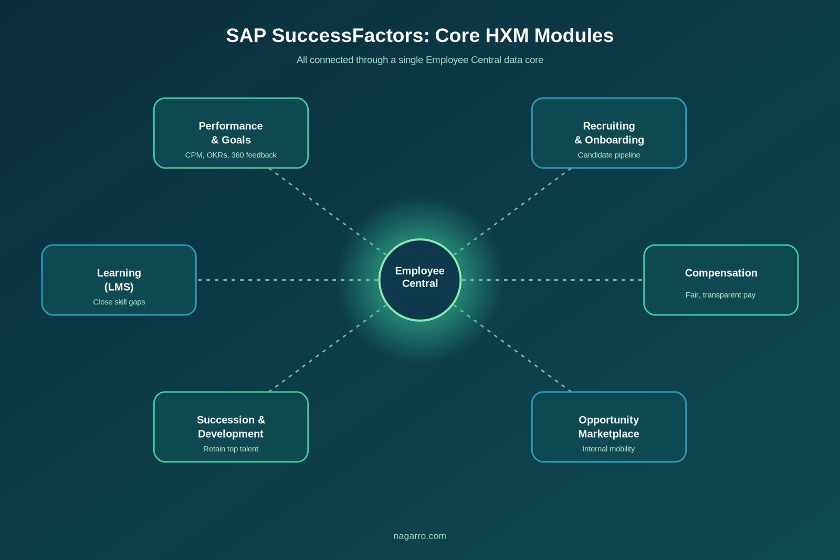
Figure 1: SAP SuccessFactors’ core HXM modules, connected through a single Employee Central data core.
The Heart of the Strategy: The Performance & Goals Module
A Culture of Continuous Feedback: Track Performance in Real Time
Continuous Performance Management (CPM) replaces the single annual snapshot with an ongoing stream of check-ins, informal feedback, and goal updates throughout the year. Instead of a manager reconstructing twelve months of work from memory, the review becomes a summary of conversations that were already happening, which makes it faster to write and far more accurate. Gallup’s research backs this up directly: employees who receive regular feedback are roughly three times more engaged than those who only get an annual review. It also changes the emotional tone of the review itself: nothing in it should come as a surprise, because the feedback loop has already been running all year.
Cascading Company Vision with OKRs (Objectives and Key Results)
SAP SuccessFactors supports OKRs (Objectives and Key Results) natively within the Performance & Goals module, giving companies a structured way to cascade strategic priorities down to team and individual goals without losing the connection between the two. The format itself is deliberately simple: a qualitative objective paired with a small number of measurable key results, which is part of why OKRs have spread so widely beyond the tech companies that popularized them.
A Practical OKRExample: Setting Goals for a Sales Department
A sales department’s OKR might look like this: Objective: Grow revenue from new customers. KR1: Generate 500 qualified leads this quarter. KR2: Convert 15% of qualified leads into paying customers. KR3: Reduce average deal cycle time from 45 to 30 days. Each key result is measurable, time-bound, and visibly tied back to the objective, which is what makes OKRs useful for cascading strategy rather than just listing tasks. A sales rep can look at their own individual goals and see exactly how hitting their number contributes to the department’s KR2, rather than working toward a target that feels disconnected from anything above it.
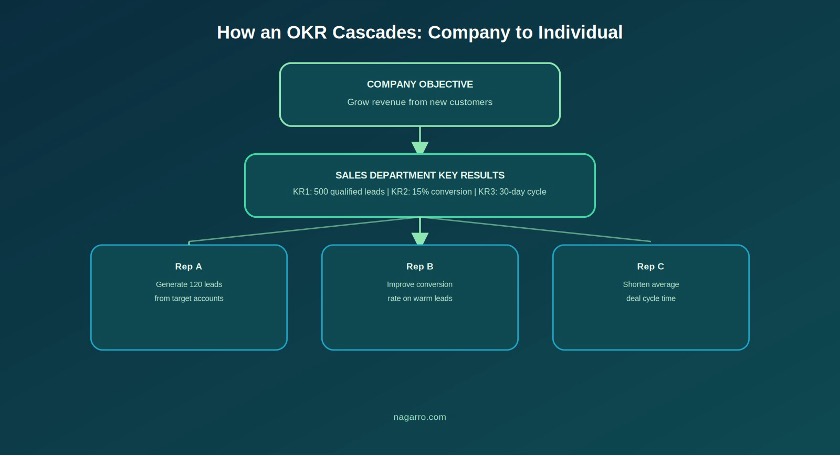
Figure 2: How a single company objective cascades into department key results and individual goals.
Competency Assessments and 360-Degree Feedback
Beyond goal tracking, SAP SuccessFactors supports structured competency assessments and 360-degree feedback, gathering input from managers, peers, and direct reports rather than relying on a single perspective. This is particularly valuable for leadership development, where blind spots are often invisible to the person who has them. A manager who consistently scores well from their own boss but poorly from direct reports is a pattern that a single top-down review would likely never surface at all.
Other Key Modules That Support Performance and Drive Efficiency
Learning (LMS): Close Performance Gaps Through Training
When a performance review or a competency assessment surfaces a skill gap, the Learning module, SuccessFactors’ built-in learning management system, lets managers assign relevant training directly, closing the loop between identifying a gap and doing something about it. This turns performance management from a purely evaluative exercise into a genuinely developmental one, since the same system that flags the gap is also the system that fixes it.
Recruiting: Automate Hiring to Win the Best Talent
The Recruiting module reduces the manual burden of sourcing and screening candidates through mobile-first candidate experiences and structured candidate relationship management, streamlining recruiting processes end to end and helping talent teams build and nurture a pipeline instead of starting from zero for every open role. Concretely, this means faster time-to-fill and less top candidate drop-off to competitors during a slow, manual process, since a strong candidate rarely stays on the market for long once other companies notice them too.
Career Development and Succession: Retain High-Potential Employees
Succession & Development gives HR and leadership visibility into who is ready for what role next, and where succession gaps exist for business-critical positions. For high performers specifically, a visible career path inside the company is often what determines whether they stay or start looking elsewhere, since ambition that goes unacknowledged internally tends to get satisfied externally instead. Structured career planning tools within this module make that path visible to the employee, not just to HR.
Compensation: Reward Performance Fairly and Transparently
The Compensation module connects pay decisions directly to performance and goal data, with modeling and forecasting tools that help ensure raises and bonuses are allocated consistently rather than depending on which manager happens to advocate hardest for their team. This consistency matters as much for perceived fairness as it does for the numbers themselves, since pay decisions that feel arbitrary tend to do more damage to trust than the amounts involved would suggest.
Employee Central: The Central Data Source Behind Every Process
Employee Central is the core HR system of record underneath all of this: organizational structure, employee data, absence management, and self-service tools that let employees update their own information and complete routine HR tasks without opening a ticket. Every other module, performance, learning, compensation, draws on the same Employee Central data, which is what keeps the whole platform consistent instead of fragmented. In practice, this also means a single change, such as an employee moving to a new team, propagates automatically to reporting lines, goal cascades, and access permissions, rather than requiring someone to update five separate systems by hand.
Preparing for the Future: AI and Next-Generation HR Tools
Your Smart HR Assistant: Get Instant Answers with SAP Joule
SAP Joule, SAP’s generative AI copilot, brings a conversational layer on top of SuccessFactors data. A manager can ask something like “Who on my team is due for a promotion review?” or “Which of my direct reports haven’t completed their compensation training?” and get an immediate answer pulled directly from the underlying HR data, without navigating through multiple screens or waiting on a report from HR. For HR business partners fielding the same handful of questions from managers every week, this shifts a repetitive support burden onto a tool that never gets tired of answering it.
Internal Talent Marketplace: Opportunity Marketplace
Opportunity Marketplace uses the same underlying skills and career data to match employees with internal projects, mentorships, or open roles they might never have found on their own. For retention, this matters more than it might seem: a significant share of voluntary turnover happens simply because employees didn’t know an internal option existed before they started interviewing externally. Surfacing those options proactively, rather than waiting for an employee to go looking for them, is often enough to change the outcome entirely.
Frequently Asked Questions About SAP SuccessFactors
Is SAP SuccessFactors suitable for small businesses?
Yes, though the value proposition shifts with scale. Smaller businesses typically start with core modules like Employee Central and Performance & Goals, expanding into recruiting, learning, and compensation as the organization grows and HR process digitalization becomes less of a nice-to-have and more of an operational necessity. Many smaller companies find that even just replacing spreadsheet-based goal tracking with Performance & Goals pays for itself in time saved during review season.
How long does migration from our current HR system to SuccessFactors take?
Timelines vary with the number of modules in scope and the complexity of existing data, but a focused migration covering core HR and one or two talent modules typically takes a few months from kickoff to go-live, with broader, multi-module rollouts taking longer and usually phased by module. Data cleanliness in the legacy system is often the single biggest factor in whether a migration finishes on schedule.
What is the most widely used SAP SuccessFactors module?
Employee Central and Performance & Goals tend to see the broadest adoption, since nearly every employee interacts with them regularly, compared to more specialized modules like Succession & Development, which are used more heavily by HR and leadership. This is also usually why companies implement those two modules first and build outward from there.
How is data security handled in SAP SuccessFactors?
As a cloud platform, SAP SuccessFactors relies on role-based access controls, regional data hosting options, and regular external audits to meet data protection requirements such as GDPR, with access to sensitive HR data restricted according to each user’s role in the organization. For multinational companies, regional hosting options are often a deciding factor, since HR data frequently falls under stricter local regulations than other business data.
Can SAP SuccessFactors integrate with our existing ERP, such as SAP S/4HANA, or other software?
Yes. SuccessFactors is built to integrate with SAP S/4HANA and other core SAP systems through pre-built integration content, and it can also connect to third-party payroll, finance, or collaboration tools through standard APIs, which is typically one of the first technical questions addressed during implementation planning. Getting this integration right early tends to prevent a lot of duplicate data entry problems later on.
Take the Next Step in Your Performance Management Digital Transformation
Moving from a once-a-year review to continuous, data-driven performance management is not a one-time project. It is an ongoing shift in how a company manages its people, and SAP SuccessFactors provides the platform to support that shift across every stage of the employee lifecycle.
With deep, hands-on SAP implementation experience, Nagarro helps HR leaders move from planning to a live, adopted system, without losing momentum somewhere in between. As part of a broader HR digital transformation, we help you scope the right starting point for your organization, whether you are exploring your first module or expanding a mature SuccessFactors landscape, and build a realistic, phased roadmap rather than a one-size-fits-all rollout.

Optimize Your SAP System with Application Management Services
Optimize Your SAP System with Application Management Services Digital transformation has been a part of our lives for a while now. And yet, its speed...
Read More
Simplifying IT Operations with Cloud ERP
How to Cut IT Maintenance Time by 50% – The Power of Cloud ERP Systems For many IT teams, routine maintenance processes are one of the biggest...
Read More
Beyond the Sales: Maximize Value with SAP Service Cloud
Beyond the Sales: Maximize Value with SAP Service Cloud In the rapidly evolving service industry, meeting customer expectations and delivering...
Read More

