
The Limits of Traditional Budgeting and the Power of Continuous Planning

Continuous Planning: Chart Your Company’s Course in Financial Uncertainty
How relevant is your budget, prepared six months ago, in today’s environment of fluctuating exchange rates, persistent inflation, and rapidly changing market dynamics?
Most organizations still conduct budgeting activities only once or twice a year. However, in an era defined by economic volatility and intensifying market competition, businesses need to revisit their budgeting processes more frequently and with far greater strategic agility.
At the same time, increasing the frequency of budgeting cycles using traditional planning methods is far from simple. Conventional approaches are often too rigid, time-consuming, and disconnected from real-time business conditions.
As a result, organizations are increasingly turning to continuous planning, a more agile, consistent, and effective approach that incorporates dynamic budgeting methods and enables faster adaptation to change.
In this article, we will explore why traditional planning methods fall short, how continuous planning works, the advantages it offers, and how your organization can implement it step by step.
Why Traditional Planning Methods Collapse in Times of Crisis
Traditional budgeting has long been the foundation of financial management. However, this model was designed for more stable economic environments. This is why dynamic budgeting and agile financial planning methods are proving far more effective in modern business environments.
Static Reports and Slow Response Times
In traditional budgeting processes, plans are typically created at the beginning of the year. In reality, business conditions rarely stay unchanged for that long.
When market conditions shift, finance teams must generate new reports to assess the current situation. In many cases, this process can take weeks.
As a result, companies are forced to make decisions based not on real-time data, but on delayed insights. This often leads to missed opportunities and misallocated investments.
Manual Processes and High Risk of Error
In many organizations, budgeting is still managed through Excel spreadsheets. While this may appear flexible at first, it creates significant challenges as operations scale.
Manual data entry, copy-paste workflows, and complex formulas all increase the likelihood of errors. Even a small formula mistake can result in financial decisions with major consequences.
In addition, the circulation of multiple file versions creates version control issues, which can undermine trust between teams. This weakens the reliability of financial planning and analysis processes.
Data Inconsistency and Lack of Cross-Functional Alignment
Under traditional planning models, each department often works with its own separate data set.
Sales teams may rely on one forecast, operations may use another, and finance is left trying to consolidate conflicting inputs. This eliminates the concept of a single source of truth.
As a result, strategic meetings often become focused on validating data rather than making decisions, slowing down the entire planning process.
The Next-Generation Approach: What Is Continuous Planning?
Continuous planning is a modern approach that makes planning more efficient, delivers accurate forecasts at the right time, and enables fast-growing businesses to gain the adaptability and agility required in changing market conditions.
Powered by technologies such as automation, machine learning, and artificial intelligence, these processes require less manual effort and lower operational costs.
Continuous planning and analysis are critical to achieving long-term business success.
This agile financial planning model offers a wide range of benefits, from creating regular alignment points with budget owners to assess performance and update business plans, to improving planning activities through automated workflows.
From Static Budgets to Dynamic and Agile Processes
Continuous planning improves the relevance, consistency, and clarity of plans, and significantly simplifies planning processes and enhances forecasting accuracy.
Instead of relying on fixed annual budgets, organizations adopt rolling forecasts and dynamic budgeting models.
In this approach, budgets are updated at regular intervals, such as monthly or quarterly, ensuring that plans remain current at all times.
As a result, finance teams move beyond simply reporting past performance and take an active role in shaping future outcomes.
The Role of Technology: Automation, AI, and Business Intelligence
At the core of continuous planning lies a strong technological foundation.
Automation eliminates repetitive manual tasks and dramatically reduces the time required for data collection and processing.
Artificial intelligence (AI) and machine learning (ML) algorithms analyze historical data to generate more accurate forecasts.
Business intelligence (BI) tools and data visualization technologies transform complex data into actionable insights, accelerating decision-making across the organization.
Core Components: Data, Collaboration, and Scenario Analysis
Continuous planning is built on three essential pillars:
- Data: Real-time, reliable, and integrated data sources
- Collaboration: Cross-functional coordination and shared business objectives
- Scenario Analysis: Testing multiple possible outcomes to minimize risk
Scenario analysis is especially valuable for CFOs, enabling them to quickly answer critical “what if” questions and make informed strategic decisions.
|
Want to discover how continuous planning can create a competitive advantage for your business? Contact us to explore the best solutions for your organization. |
5 Proven Advantages of Transitioning to Continuous Planning
Continuous planning is a strategic transformation model that enables organizations to become more resilient, more predictive, and more competitive in rapidly changing economic conditions.
With real-time data flows, automation, AI-driven forecasting, and scenario analysis, companies are not only managing the present but also building stronger visibility into the future.
Research shows that organizations adopting continuous planning complete planning cycles faster, significantly improve forecast accuracy, and reduce response time to risks.
Let’s take a closer look at five key advantages of continuous planning for businesses.
1. Radical Agility and Real-Time Decision Making
In traditional budgeting systems, decision-making often depends on reporting cycles that take weeks to complete. Continuous planning eliminates this delay through real-time data access.
For example, when there is a sudden increase in exchange rates, a company using continuous planning can immediately assess the impact on cash flow and take action on the same day.
This approach can reduce decision-making time by up to 50 percent.
2. Up to 30 Percent More Accurate Financial Forecasts
Forecast accuracy plays a critical role in the success of financial planning.
While traditional models rely heavily on historical data, continuous planning analyzes multiple data sources simultaneously.
AI and machine learning-based forecasting models take into account sales trends, seasonal fluctuations, market dynamics, and external economic factors, resulting in more realistic and reliable projections.
Budget variances can be reduced by 20 to 30 percent. This enables better resource allocation and more confident investment decisions.
3. Improved Operational Efficiency and Cost Savings
Manual data collection, version tracking across spreadsheets, and repetitive reporting tasks consume a significant amount of time for finance teams. Continuous planning removes these bottlenecks.
With automation tools, data entry, consolidation, and reporting become fully automated. This allows finance teams to redirect up to 40 percent of their time from manual work to strategic analysis.
This increases workforce productivity, reduces operational costs, minimizes human error, and creates leaner processes.
4. Elevating the Financial Intelligence of the Entire Organization
One of the most powerful benefits of continuous planning is the democratization of financial data across the organization.
In traditional structures, financial information is often limited to the finance department. In modern planning systems, all departments have access to the same data.
Sales, operations, human resources, and supply chain teams can see financial impacts in real time and align their decisions accordingly.
Data visualization dashboards make complex financial information easy to understand for everyone. This increases data literacy across the organization and fosters a more informed decision-making culture.
5. Proactive Risk Management and Opportunity Identification
In today’s financial environment, managing risks after they occur is no longer sufficient. Anticipating them in advance is essential.
Continuous planning enables companies to test different scenarios before they happen through advanced scenario modeling.
For instance, scenarios such as a 15 percent increase in raw material costs, a 10 percent decline in sales volume, or sudden currency fluctuations can be modeled in advance. This ensures that companies are not caught unprepared during periods of disruption.
At the same time, this system identifies risks and highlights opportunities early.
New investment areas, profitable market segments, and high-growth potential opportunities can be detected faster.
This provides companies with not only a defensive advantage but also a strategic offensive edge.
How SAP SAC Automates Continuous Planning Processes
A successful continuous planning approach requires a powerful, integrated, and scalable technology foundation.
SAP Analytics Cloud (SAP SAC) is not just a reporting tool. It is a comprehensive platform that combines analytics, planning, forecasting, and AI-driven decision-making capabilities in a single environment.
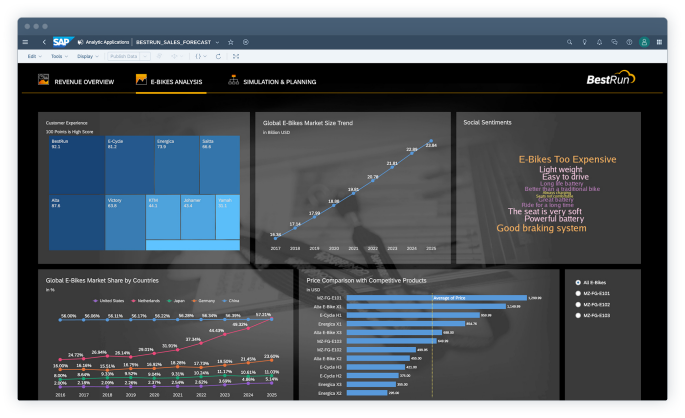
SAP SAC brings together finance, supply chain, and operations planning under one roof, helping organizations move away from fragmented systems.
This enables faster decision-making and ensures that the entire organization operates on a unified data foundation.
Predictive Forecasting to Anticipate the Future
One of the strongest capabilities of SAP Analytics Cloud (SAP SAC) is its AI and machine learning-powered predictive forecasting features.
The system analyzes historical performance data to generate more accurate financial projections for the future.
In addition, SAP Analytics Cloud (SAP SAC), includes Joule, its generative AI-powered assistant, which accelerates reporting, insight discovery, and business planning processes.
With Joule, users can ask data questions in natural language, receive instant analysis, and build complex scenario models with greater ease and speed.
Interactive Dashboards for Clear and Actionable Insights
For data to create value, it must be understandable and accessible.
SAP Analytics Cloud (SAP SAC) transforms complex financial data into simple, visual, and actionable insights through advanced dashboarding and data visualization capabilities.
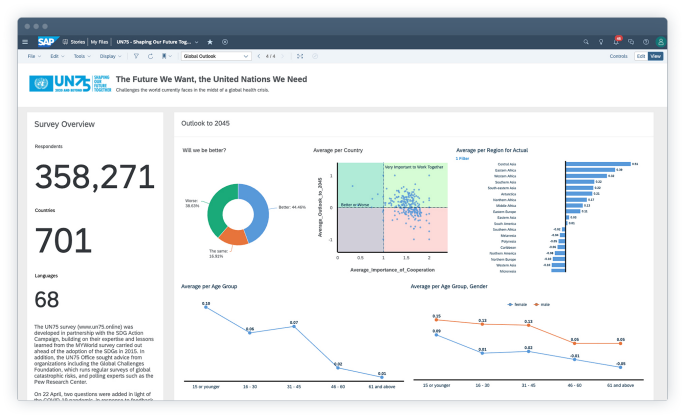
Predefined KPI sets, industry-specific analytical content, and customizable reporting dashboards allow managers to access the information they need from a single screen.
For example, a CFO can monitor cash flow, budget performance, and profitability metrics in real time from one dashboard, quickly identifying deviations and taking immediate action.
This significantly reduces the time needed to turn data into insights.
A Single Source of Truth for All Teams
One of the biggest challenges in continuous planning is the use of different data sources across departments.
SAP Analytics Cloud (SAP SAC) addresses this issue by consolidating all data into a single platform.
With SAP Datasphere integration, data preparation, modeling, planning, and analytics processes are managed within one unified data management system.
This ensures that finance, operations, sales, and supply chain teams work with the same dataset.
Furthermore, its integration with solutions such as SAP S/4HANA, SAP SuccessFactors, and SAP Integrated Business Planning transforms SAP SAC into a true extended planning and analysis (xP&A) platform.
This structure aligns not only the finance department but the entire organization toward the same strategic objectives.
Traditional Planning vs. Continuous Planning (Comparison Table)
| Criterion | Traditional Planning | Continuous Planning |
| Update Frequency | Annual | Continuous / Rolling |
| Data Structure | Static | Real-time |
| Processes | Manual | Automated |
| Error Risk | High | Low |
| Decision Making | Delayed | Real-time |
| Collaboration | Limited | High |
| Flexibility | Low | High |
A 3-Step Roadmap to Transitioning Your Organization to Continuous Planning
Transitioning to continuous planning is not only a technology shift.
It is an organizational transformation that fundamentally changes how finance teams work, how data is used, and how decisions are made.
For a successful transition, the most critical factor is managing this change in a structured and phased way. Sudden and unplanned implementations can lead to data consistency issues and low user adoption.
Below, you will find a detailed 3-step roadmap to successfully implement continuous planning in your organization.
Step 1: Current State Analysis and Needs Assessment
The first and most critical step in a continuous planning transformation is to clearly analyze the current state of the organization.
Without understanding where you are starting from, it is impossible to design an effective transformation strategy.
At this stage, end-to-end budgeting and reporting processes should be evaluated. In particular, Excel-based manual workflows, data consolidation steps, and the systems used across different departments must be reviewed in detail.
It is also important to identify where reporting delays occur, where data inconsistencies arise, and where decision-making processes slow down.
This analysis is not only a technical assessment but also a key step in understanding the organization’s financial maturity level.
It forms the foundation of the entire transformation roadmap and ensures that the following steps are designed correctly.
Step 2: Selecting the Right Technology and Implementation Partner (Nagarro)
In continuous planning success, the choice of technology is as important as the expertise of the implementation partner.
A powerful tool alone is not enough. What truly matters is how effectively it is integrated into business processes.
Platforms like SAP Analytics Cloud (SAP SAC) may not deliver their full potential if not properly implemented. This is why working with a partner that combines technical expertise with strong financial process knowledge is critical.
Nagarro supports organizations end-to-end in this transformation with its expertise in SAP SAC solutions.
It provides support across all stages, including assessment of existing systems, solution architecture design, data modeling, and user adoption.
This approach ensures that companies do not just implement software, but achieve a sustainable financial planning transformation.
Step 3: Pilot Implementation, Training, and Rollout
One of the most common mistakes in continuous planning transformations is deploying the system across the entire organization at once. This approach often leads to adoption challenges and operational disruptions.
For this reason, the transformation should always begin with a pilot implementation. A specific business unit or department is selected to test the new planning model in a real business environment.
This phase provides a critical opportunity to evaluate system performance under real operating conditions.
Based on feedback from the pilot, the system is improved, processes are optimized, and potential issues are resolved.
The next step is training. Finance teams and relevant stakeholders should receive comprehensive training to ensure smooth adoption. These sessions should cover not only technical usage but also the logic behind the new planning approach.
Finally, the system is gradually rolled out across the entire organization.
This controlled approach minimizes risks and ensures a smoother and more successful user adoption process.
Conclusion: The Future of Finance Is Continuous, Dynamic, and Data-Driven
Traditional budgeting is struggling to keep up with the pace of today’s business environment.
Static structures, manual processes, and data inconsistencies significantly limit a company’s competitive advantage. In contrast, continuous planning transforms finance functions by enabling agility, accuracy, and strategic foresight.
This is no longer a matter of preference. It is a critical requirement for sustainable growth.
In the future, the most successful organizations will be those that treat finance not just as a control mechanism, but as a strategic driver of business direction.

Integrating SAP S/4HANA with SAP CX Solutions
Integrating SAP S/4HANA with SAP CX Solutions Nowadays, delivering the ultimate customer experience requires more than just enhancing operational...
Read More
Will RPA Take Our Jobs? The Future of Work and Emerging Opportunities
Will RPA Take Our Jobs? The Future of Work and Opportunities One of the most frequently asked questions in today’s era of digital transformation is...
Read More
Next-Generation Solutions in Human Resources Management
Next-Generation Solutions in Human Resources Management Digital transformation continues to change our life and work practices day by day. As we try...
Read MorePlease contact us for further information


